Showing posts with label livinghistory. Show all posts
Showing posts with label livinghistory. Show all posts
Monday, July 17, 2006
Historic Fort Boonesborough and Boone's Station
I always have a good time when I go to Boonesborough, and now living history opportunities are opening up at Boone's Station as well. Here is a link to current happenings at Boonesborough and Boone's Station.


Thursday, July 13, 2006
New Frontier Resources blog
Frontier Resources now has it's own blog. I will continue to post some things here, but most Frontier Resources specific information will now be posted on that blog.
Saturday, July 01, 2006
Hands On History - Spring 2006 - Town Meeting
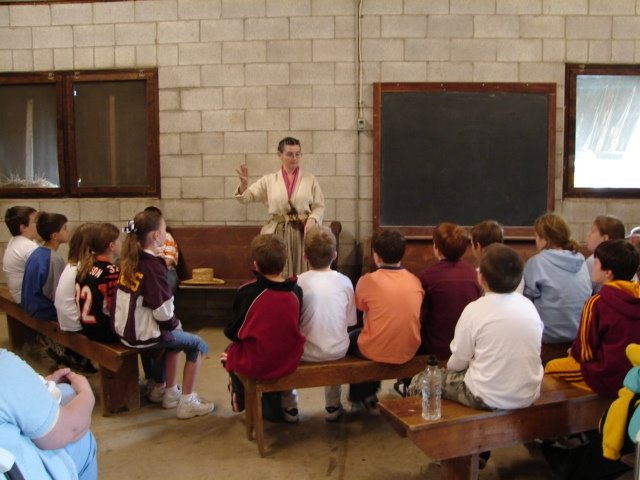
Here I am holding our Town Meeting, where students re-enact a Town Meeting in early America, learning about democracy and voting rights.
Hands On History - Spring 2006 - Woodworking
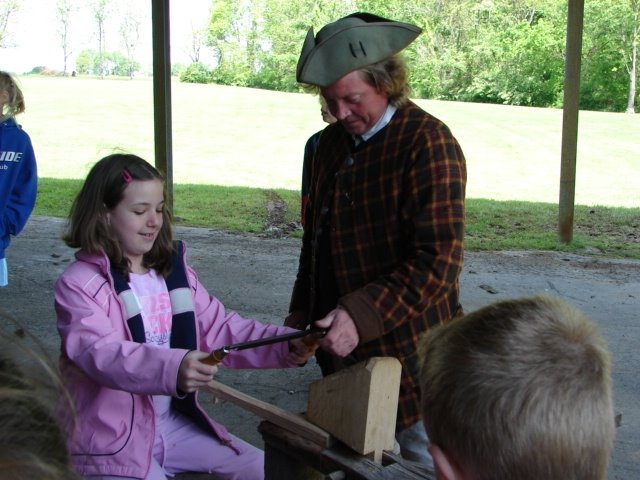 Mike Thompson teaches about woodworking. Here we see a student learning to use a draw knife.
Hands On History - Spring 2006 - Oxen and Wagon
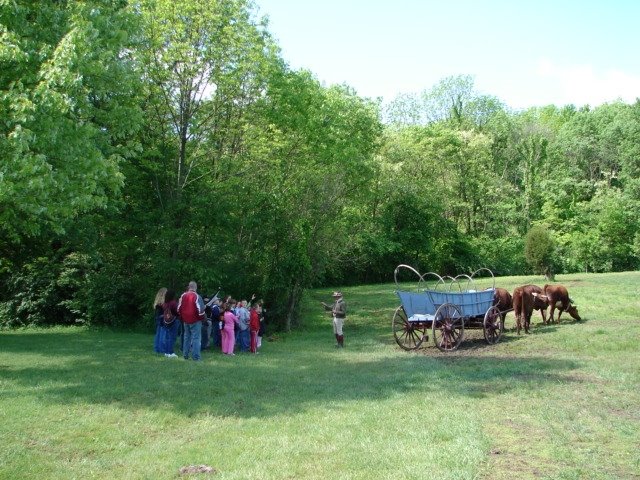 Wilmington Meeting members took some photos at Quaker Knoll Campground during the Spring session of the Hands On History program.
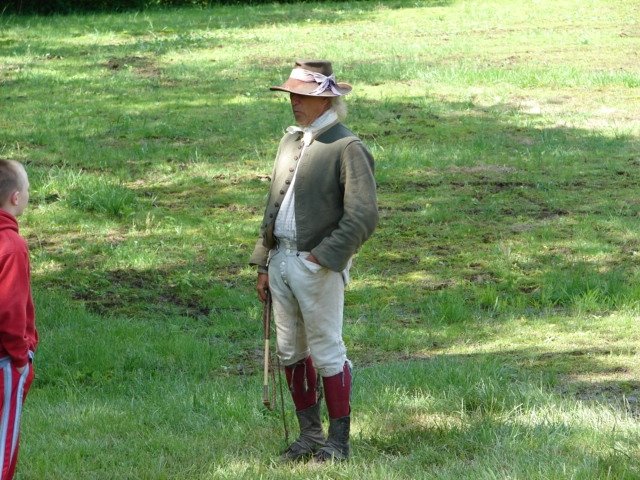
Here we have a group of students attending the Oxen/Freight station. Below is Gerry Barker teaching about early Freight.
Thursday, June 29, 2006
Hands On History - Brief description of topics
Some of the topics our Hands On History program may include, but are not limited to:
Our 2006 Autumn program runs October 3-6, 9-13 and 16-17, 2006. Our 2007 dates are May 14-24, 2007 and Oct 1-11, 2007. The program takes about 4 hours, running from 9:30 a.m. until 2:00 P.M, or as your busing schedule permits. Cost is $5.00 per student. There is no cost for teachers and chaperones.
Please contact me for additional information, or to schedule your visit.
OXEN- An explanation of the importance of oxen to early
QUAKER HISTORY - Early Quaker History and how Quaker's influenced Southwestern Ohio and the Early United States.
CHILDREN’S WORK- A view of the importance of children on the frontier while they work to shape a grindstone.
FRONTIER
TOWN MEETING- Students experience frontier democracy by taking part in a town meeting and wrestling with a vital issue of the day.
SPINNING- An introduction to the problem of cloth supply for the
CHILDREN’S GAMES- A look at entertainment on the frontier while students try an outdoor game of the 1800s.
WESTERN MOVEMENT -
INDENTURED SERVITUDE- Forty percent of the population of Colonial America arrived under terms of indenture. This station examines the lives of the children who found themselves so situated.
Our 2006 Autumn program runs October 3-6, 9-13 and 16-17, 2006. Our 2007 dates are May 14-24, 2007 and Oct 1-11, 2007. The program takes about 4 hours, running from 9:30 a.m. until 2:00 P.M, or as your busing schedule permits. Cost is $5.00 per student. There is no cost for teachers and chaperones.
Please contact me for additional information, or to schedule your visit.
Monday, June 26, 2006
Jumps Research - Recreating Cries of London 'Strawberries, Scarlet Strawberries'
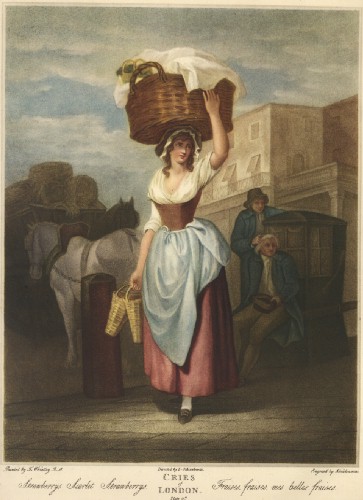
One of the pictures we found in our jumps research is a Cries of London Mezzotint called 'Strawberries, Scarlet Strawberries'. We poured over this, looking at the details, trying to figure out what is she wearing?
She appears to be wearing a shift, as one would expect from that time, even though it is not always visible. In this case we can see the sleeves. We can see she is wearing a white modesty piece/kerchief over the shift, made of what appears to be a very thin, light weight fabric, tucked into the upper-body brown garment.
We can see that the garment does not cover the bust. It appears to stop below it, and possibly curve around it. We cannot see how the Strawberry seller's garment is attached, nor whether it goes over the shoulders. Could these be jumps?
Going on the fact that a tight fitted garment that is not boned won't stay up, we decided to assume that there is some sort of shoulder aspect to the garment. We created a pattern that is like a tight-fitted vest that instead of covering the bust, goes under it, like the garment in this picture, supporting the bust some on the sides. What basically happens is that the shift is held in place by this garment, the shift then holding and providing support to the bust.
I created a garment from this pattern, did a number of adjustments to the fit, and finally got something I was happy with. It is possible the original laces or hooks behind. For my ease the garment I made laces up the front with a hook and eye at the very top. I need to be able to dress myself, and hooks or lacing behind requires help.
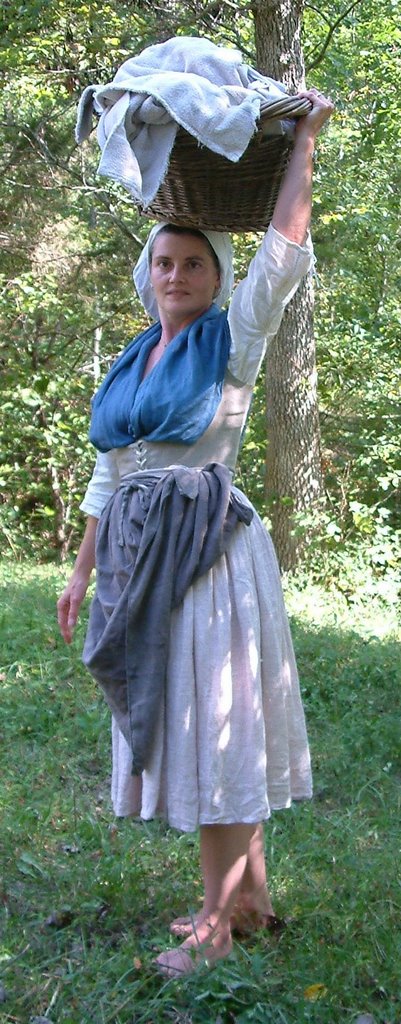
Here is a picture of the final result, noting that the fabrics and colors are nothing like the original, and of couse I'm much older as well. We didn't get the right angle, but I think this photo shows how the jumps fit the body along the sides. The bust edge of the jumps are covered by the blue modesty piece. The shoulder straps curve around where the arm attaches to the shoulder, giving freedom of the movement through the shoulders that is needed to work.
Results: I've found jumps to be extremely comfortable for low-impact work. Just the sorts of work one would expect to be doing most of the time. In fact, they are more comfortable than many modern bras.
18th Century women's wear - Stays vs Jumps
In addition to my research on petticoat length I also have been researching jumps and stays. I found it very difficult to nearly impossible to do many tasks that a woman living in the 18th century would have to do. A woman who must take care of things, that is. My character is an active, working woman. She does not have servants who will care for her and do physical tasks as might a wealthy woman.
Stays, for those who do not know, are essentially a supporting undergarment. Both men and women wore stays, although they were primarily for women as I understand it. Stays are worn over a shift/chemise, but under outer garments, especially the upper body garment. Stays are a precursor to what we are familar with as a corset, however, they were not generally worn to the tightness used in the 19th Century, as shown in Gone With The Wind.
Stays do a number of things. They helped to give the body the then-ideal cylindrical shape to the ribcage. They help support the back. And they also support the bust. There really isn't room for the bust in them, which explains the rather shelf-like effect. They certainly will bring any cleavage to immediate notice!
The first pair of stays I had was a typical back-lacing style, without tabs. While I found that my back didn't hurt after a long day of spinning or cooking, by mid- to late-afternoon they started to hit my hips just above my waist, which was very uncomfortable. This is probably due to not having tabs, but I'm not sure, not having worn this style with tabs.
My breathing was also restricted, making hurrying for any distance or running impossible. Of course, with boning from bust to below the waist, I was prevented from bending over or moving very well.
So, how can a woman who must bend over, pick things up, work with large animals or otherwise move around and do things do this in stays? The conventional re-enacting wisdom of the time said "women wore stays". How can this be? I decided there had to be more to the story.
With help from dear friends who are expert researchers in the time period and location I'm interested in, Middleground Kentucky, 1775-1776, references were found to something called jumps. No extant examples had been identified or seen in museums (my friends visit a lot of museums looking for period clothing), but there were references to both unboned and lightly boned jumps. So what are jumps? How can we tell what they were? Some references were for jumps being purchased for a woman who was pregnant or nursing. Some just referenced along with other clothing purchases.
We poured over period artwork and began to notice certain things. We all knew what a woman wearing stays looked like, what sorts of limitations on her movement stays make. We were able to identify a lot of artwork of women who by their positions or the way they looked were clearly not wearing stays. So what were they wearing? We couldn't always tell, but many had some sort of upper body garment on over a shift, with a kerchief covering the bust area but then going into some kind of upper body garment. In most cases the arms were clearly only covered by the arms of the shift. These were all pictures of women doing some sort of work, from carrying baskets, to taking care of children.
Below are some pictures I've found of women wearing jumps. I will make another post with another picture and our modern recreation of it later.
Jean Siméon Chardin
The Laundress
Jean-Honoré Fragonard
A Young Girl Reading - this young lady is clearly not wearing stays. My best guess is that she's wearing jumps under her gown.
Education is Everything - This looks like jumps, or possibly a corset blanc, which leads me to the question is a corset blanc another name, perhaps the French name, for jumps?
Stays, for those who do not know, are essentially a supporting undergarment. Both men and women wore stays, although they were primarily for women as I understand it. Stays are worn over a shift/chemise, but under outer garments, especially the upper body garment. Stays are a precursor to what we are familar with as a corset, however, they were not generally worn to the tightness used in the 19th Century, as shown in Gone With The Wind.
Stays do a number of things. They helped to give the body the then-ideal cylindrical shape to the ribcage. They help support the back. And they also support the bust. There really isn't room for the bust in them, which explains the rather shelf-like effect. They certainly will bring any cleavage to immediate notice!
The first pair of stays I had was a typical back-lacing style, without tabs. While I found that my back didn't hurt after a long day of spinning or cooking, by mid- to late-afternoon they started to hit my hips just above my waist, which was very uncomfortable. This is probably due to not having tabs, but I'm not sure, not having worn this style with tabs.
My breathing was also restricted, making hurrying for any distance or running impossible. Of course, with boning from bust to below the waist, I was prevented from bending over or moving very well.
So, how can a woman who must bend over, pick things up, work with large animals or otherwise move around and do things do this in stays? The conventional re-enacting wisdom of the time said "women wore stays". How can this be? I decided there had to be more to the story.
With help from dear friends who are expert researchers in the time period and location I'm interested in, Middleground Kentucky, 1775-1776, references were found to something called jumps. No extant examples had been identified or seen in museums (my friends visit a lot of museums looking for period clothing), but there were references to both unboned and lightly boned jumps. So what are jumps? How can we tell what they were? Some references were for jumps being purchased for a woman who was pregnant or nursing. Some just referenced along with other clothing purchases.
We poured over period artwork and began to notice certain things. We all knew what a woman wearing stays looked like, what sorts of limitations on her movement stays make. We were able to identify a lot of artwork of women who by their positions or the way they looked were clearly not wearing stays. So what were they wearing? We couldn't always tell, but many had some sort of upper body garment on over a shift, with a kerchief covering the bust area but then going into some kind of upper body garment. In most cases the arms were clearly only covered by the arms of the shift. These were all pictures of women doing some sort of work, from carrying baskets, to taking care of children.
Below are some pictures I've found of women wearing jumps. I will make another post with another picture and our modern recreation of it later.
Jean Siméon Chardin
The Laundress
Jean-Honoré Fragonard
A Young Girl Reading - this young lady is clearly not wearing stays. My best guess is that she's wearing jumps under her gown.
Education is Everything - This looks like jumps, or possibly a corset blanc, which leads me to the question is a corset blanc another name, perhaps the French name, for jumps?
Subscribe to:
Posts (Atom)