The hand spinning has been going wonderfully. I so much enjoy the process of making yarn, the feel of the fibers sliding into the twist, flowing through my hands. The dark silver CVM (California Variegated Mutant) type wool I've been spinning is now in 2 huge skeins ready to be balled and knit. They are 6 7/2 and 6 3/8 ounce, respectively. I ended up with 5 bobbins spun on my Mazurka which I plied into a 2-ply using the jumbo head on my Lendrum.
I'm now working on 4 drum carded batts of a silver-white from the same fleece. I'm about a quarter of the way through spinning that to match the dark silver. I expect about a single bobbin of this silver-white, which I expect to use as contrast on whatever garment I decide to knit of the dark silver.
Spinning this fleece was a bit of a challenge for me, as I've not had much experience spinning from carded batts, and because I wanted to spin it worsted weight. My usual spinning is very fine, so allowing so many more fibers into the twist, making a much thicker yarn, meant I had to slow way down. It worked, though, and I'm totally thrilled that I was able to stay pretty much in range of my target sample through 5 whole bobbins of yarn!
When I get a chance I'll get some pictures.
Friday, August 17, 2007


Sunday, August 12, 2007
Limoncello & Mandrinetto
A few years back my husband was traveling to Europe fairly regularly. On some of his trips he brought home Limoncello, a lemon cordial, and Mandrinetto, a tangerine cordial. Both are very good. My husband's boss learned I make cordials and sent me the below recipe. He has a lemon tree, and had tried it and liked it.
I tried the recipe, too, and it sure came out well.
Last November, when the Clementines showed fresh in my local market we got a nice flat of them and decided to try the Limoncello recipe on them, hoping that would make Mandrinetto. Clementines have very thin skin, so we ended up just grating it off, as it didn't come off well with a peeler. It turned a lovely orange color, and seemed to be working up quite fine.
After straining a thin layer of rind from the grating came to the top in addition to the expected small bits that settled to the bottom. I didn't think it was going to be possible to rack the clear liquid from between them, so I used a coffee filter in a funnel and strained it all. Came out wonderfully clear, and it's got lovely flavor. It's not as dark in color as commercial Mandrinetto, which appears to have been colored orange, but the aroma and taste are fantastic!
"This is the one I used but I have immersed the lemon zest for a much longer period to get a fuller flavour!
From JB, who kindly posted this to the BBS: - Here is a Limoncello recipe from the food section of the San Francisco Chronicle of several months ago.
INGREDIENTS:
• 15 thick-skinned lemons (Eureka, Lisbon or Citron)
• 2 bottles (750 ml each) of the best 100 proof Vodka
• 4 1/2 cups sugar
• 5 cups water
INSTRUCTIONS:
Wash the lemons in hot water before you start. Remove the peel with a vegetable peeler, removing all white pith on the back of the peel by scraping with a knife, and put the peels in a 4-quart Mason jar. Add 1 bottle of Vodka and stir. Cover the jar, date it, and put it to rest in a dark cabinet at room temperature.
After 40 days, take out the lemon-Vodka mixture. Ina sauce pan set over high heat, stir the sugar and water together and boil for 5 minutes. Let the sugar syrup cool completely in the pan, about 10 minutes. Add the sugar syrup to the lemon-Vodka mixture along with the second bottle of Vodka.
Stir well to combine. Replace the cover on the jar and note the finish date. Return it to the dark cabinet and store for 40 more days.
At day 80, remove the limoncello from the cabinet. Strain the mixture and discard the lemon peel.
Pour into clean, unused bottles with caps or decorative corked bottles. Store the bottles in the pantry, but put one bottle at a time in the freezer until ready to use. "
I tried the recipe, too, and it sure came out well.
Last November, when the Clementines showed fresh in my local market we got a nice flat of them and decided to try the Limoncello recipe on them, hoping that would make Mandrinetto. Clementines have very thin skin, so we ended up just grating it off, as it didn't come off well with a peeler. It turned a lovely orange color, and seemed to be working up quite fine.
After straining a thin layer of rind from the grating came to the top in addition to the expected small bits that settled to the bottom. I didn't think it was going to be possible to rack the clear liquid from between them, so I used a coffee filter in a funnel and strained it all. Came out wonderfully clear, and it's got lovely flavor. It's not as dark in color as commercial Mandrinetto, which appears to have been colored orange, but the aroma and taste are fantastic!
Monday, August 06, 2007
Mocha Delight - Coffee Cordial
I sometimes enjoy a cup of milk, cocoa or coffee with some coffee cordial in it. A couple of years ago, when I started making cordials at home, I tried the recipe my book had for coffee cordial, hoping to be able to make my own version of 'Kahlua' or something like. I'd done taste testing years before, trying various coffee liqueurs side-by-side, and found Kahlua and Kamora to be the best. Kamora was quite a bit cheaper, so I rarely got Kahlua.
My new book had a recipe for coffee cordial, so I tried it. And didn't like it much. So I put the idea of making my own out of my head as I had plenty of other things to try! Then one day my husband asked me why I hadn't been making my own coffee liqueur. We decided to see if other recipes were better, and did a lot of searching on the internet, as well as going through my now slightly larger library of such books.
We found a lot of recipes, many similar, and next thing I knew, my husband was cooking up recipes! He rarely drinks, but he's an awesome cook, and I very much appreciate his interest. We did a bunch of trials, mixing up tiny batches of likely-looking recipes, and tried them. We then made some recipe adjustments based on taste preferences, and made some more. A few rounds of this and we ended up with the below recipe, which I call Mocha Delight. It can be cut or multiplied. These instructions make about a gallon.
This can be used immediately, and will last well without need of refrigeration. I do not recommend using higher proof Vodka, as it will give a harsh taste.
My new book had a recipe for coffee cordial, so I tried it. And didn't like it much. So I put the idea of making my own out of my head as I had plenty of other things to try! Then one day my husband asked me why I hadn't been making my own coffee liqueur. We decided to see if other recipes were better, and did a lot of searching on the internet, as well as going through my now slightly larger library of such books.
We found a lot of recipes, many similar, and next thing I knew, my husband was cooking up recipes! He rarely drinks, but he's an awesome cook, and I very much appreciate his interest. We did a bunch of trials, mixing up tiny batches of likely-looking recipes, and tried them. We then made some recipe adjustments based on taste preferences, and made some more. A few rounds of this and we ended up with the below recipe, which I call Mocha Delight. It can be cut or multiplied. These instructions make about a gallon.
Mocha Delight
In a large sauce pan put:
2 quarts water
1/2 cup instant coffee (I use decaf)
2 Tbsp chocolate syrup (or to taste, I often squirt in a bit more)
4 cups, which is 2 1-lb packages, of dark brown sugar
2 cups sugar
Bring to boil, then boil for 5 minutes. Turn off the heat and leave
until cool. I generally do this right before bed, then leave it to
cool overnight.
If your pan will hold a gallon you can just add the last 2 ingredients
to it, otherwise get a container that will hold a gallon and put into
it:
2 Tbsp vanilla extract
4 cups 80-proof vodka (I generally use Schmirnof's red label)
Add the coffee mixture. Stir to blend well, then put in clean bottles.
This can be used immediately, and will last well without need of refrigeration. I do not recommend using higher proof Vodka, as it will give a harsh taste.
Elderberry Cordial
Over the 4th of July my mother and I started some Elderberry Cordial using the recipe in "Cordials from Your Kitchen". I've made this before, and it's wonderful! The berries were some Mom had picked last year and frozen. We put the frozen berries straight into the mix. Per instructions I've shaken the containes (quart and other such jars) every few days.
Yesterday was the day to strain the cordial. It sure is lovely. Dark, rich purple, and the smell is heavenly. A week of settling then I'll rack it and put it into nice bottles.
Yesterday was the day to strain the cordial. It sure is lovely. Dark, rich purple, and the smell is heavenly. A week of settling then I'll rack it and put it into nice bottles.
Sunday, August 05, 2007
Spinning again
It's been a while since I've posted and a lot has been going on. Now that things have settled down just a bit I've gotten back to handspinning. I spun some Targhee, then decided it was time to spin some CVM I've had waiting for just the "right time". This fiber was from a fleece I'd purchased, washed and then carded up on a drum carder. It's been waiting for quite a while.
I spun up some samples, which was a bit interesting, as I've not spun from carded bats much. I settled on a 2-ply worsted weight yarn. The singles are spun on the 6:1 ration of my Mazurka spinning wheel, with about 21 degrees of twist, about 17 wpi. The finished 2-ply is 8 wpi. I've been using techniques I learned from Rita Buchanan in a spinning for knitting class to match my sample.
I've spun 4 bobbins, and have enough more fiber to do another bobbin, possibly 2. I'll ply it up mixing up the bobbins so the first is plied with the 3rd or whatever is the middle one, and so on.
I'm still deciding how to knit it up. I'm thinking a from-the-top, seamless sweater ala Barbara Walker. This CVM is a medium silver-gray, too dark to show cables all that well. The yarn is a bit randomly heathered, so should be quite interesting enough without much fussiness.
I spun up some samples, which was a bit interesting, as I've not spun from carded bats much. I settled on a 2-ply worsted weight yarn. The singles are spun on the 6:1 ration of my Mazurka spinning wheel, with about 21 degrees of twist, about 17 wpi. The finished 2-ply is 8 wpi. I've been using techniques I learned from Rita Buchanan in a spinning for knitting class to match my sample.
I've spun 4 bobbins, and have enough more fiber to do another bobbin, possibly 2. I'll ply it up mixing up the bobbins so the first is plied with the 3rd or whatever is the middle one, and so on.
I'm still deciding how to knit it up. I'm thinking a from-the-top, seamless sweater ala Barbara Walker. This CVM is a medium silver-gray, too dark to show cables all that well. The yarn is a bit randomly heathered, so should be quite interesting enough without much fussiness.
Tuesday, January 02, 2007
Showtime Rotisserie
A couple months ago my husband purchased a countertop rotisserie. The idea was to use it to roast coffee, as well as to cook. We've used it quite extensively, and I highly recommend it. I think it's about the best way to cook most meats. It will roast 2 chickens at a time, or the basket can be used for steaks, veggies or other flat items. It takes no longer than using the regular oven, doesn't heat up the whole house, and the food is wonderfully tender and juicy.
There are several additional things that it either can come with, or that you can get separately, including 2 sizes of baskets and skewers. Some packages come with a warming try that can be put on top.
A lot of thought went into the design. The drip tray is square, so there's no 'wrong' way to put it in. The spit can go in either way, so you just use it. It comes with a gray plastic disk that takes the gear shaft and holds the spit vertically, allowing you to position the foods/baskets on it without it falling over, and which will protect the table/counter when taking food off.
All in all, I highly recommend these rotisserie ovens. They take up about the same amount of space as a breadbox, coming in several sizes to suit your needs.
There are several additional things that it either can come with, or that you can get separately, including 2 sizes of baskets and skewers. Some packages come with a warming try that can be put on top.
A lot of thought went into the design. The drip tray is square, so there's no 'wrong' way to put it in. The spit can go in either way, so you just use it. It comes with a gray plastic disk that takes the gear shaft and holds the spit vertically, allowing you to position the foods/baskets on it without it falling over, and which will protect the table/counter when taking food off.
All in all, I highly recommend these rotisserie ovens. They take up about the same amount of space as a breadbox, coming in several sizes to suit your needs.
Wednesday, August 23, 2006
Vegetable Stock, a nice side effect of canning corn
We recently spent a day canning. Started first thing in the morning in the garden, picking corn and shucking it. Nice activity for a lovely summer morning. Then on into the house to cut and can the corn.
The corncobs seemed like too much goodness to just put back in the compost, so we made vegetable stock. Got two big stockpots for the cobs, added a few tomatoes, some green beans, kohlrabi, onions, carrots including their greens, fresh herbs and a few dried. Used our new 21,000 BTU burner and the side burner on our grill to make the stock. Let it cook slowly over several hours, took the stock off, added more water and did it again. And again! In the end we had 26 quarts of stock. We mixed the 3 different batches together so they would all be about the same concentration.
Wonderful start to some soups this winter!
The corncobs seemed like too much goodness to just put back in the compost, so we made vegetable stock. Got two big stockpots for the cobs, added a few tomatoes, some green beans, kohlrabi, onions, carrots including their greens, fresh herbs and a few dried. Used our new 21,000 BTU burner and the side burner on our grill to make the stock. Let it cook slowly over several hours, took the stock off, added more water and did it again. And again! In the end we had 26 quarts of stock. We mixed the 3 different batches together so they would all be about the same concentration.
Wonderful start to some soups this winter!
Friday, August 11, 2006
Brined Zucchini Pickless Need More Work
Well, I'm not satisfied with how the brined zucchini pickles turned out. More experimentation is needed. Some possibilities are that they were cut, not whole, and that I may not have had a strong enough brine solution. When I get a chance I'll try some more with other solutions.
Monday, July 31, 2006
Monday, July 24, 2006
Brining Zucchini Pickles
On Friday I started some brined zucchini pickles. I happened to stop at a local discount store and saw a lovely, large glass vase. Clear glass, with a sort of swirled pattern, about 18-20 inches tall, lovely shape, narrowing down to an opening still large enough for me to put my hand in. Hmmm, looked perfect for pickles! And only $5.00. Home it came. I cleaned it, then tried to decide how to use all the lovely zucchini.
I decided on spears, since the zucchini's were pretty good sized (say mostly 3-day zuke's). We chunked them into spears about 3.5 to 4 inches long, either quartering each section, or cutting it into 8ths, depending on how big they were. As I layered the spears into the jar I added a pickling mix that we had purchased. I'd just found out the day before that pickling mixes were initialy intended for brined pickles, and this was my chance to try this one out.
Mixed up brine and put it over the full jar. I then used some of the remainder in a sandwich baggie, double bagged, which I put on top to keep the new pickles under the brine. It started bubbling by the next day. The spears are reducing in size, I presume as the salt pulls the water out of the spears. They sure look good. They should be ready in about 2 weeks.
I decided on spears, since the zucchini's were pretty good sized (say mostly 3-day zuke's). We chunked them into spears about 3.5 to 4 inches long, either quartering each section, or cutting it into 8ths, depending on how big they were. As I layered the spears into the jar I added a pickling mix that we had purchased. I'd just found out the day before that pickling mixes were initialy intended for brined pickles, and this was my chance to try this one out.
Mixed up brine and put it over the full jar. I then used some of the remainder in a sandwich baggie, double bagged, which I put on top to keep the new pickles under the brine. It started bubbling by the next day. The spears are reducing in size, I presume as the salt pulls the water out of the spears. They sure look good. They should be ready in about 2 weeks.
Thursday, July 20, 2006
Domes and Clips
I was looking for some replacement clips for one that had broken and happened across this site. Since I live in a Geodesic dome, I really liked seeing some more. Putting our firewood inside a shelter like this might be nice, too.
The clips look good, too, and I'll probably get some in various sizes at some point.
The clips look good, too, and I'll probably get some in various sizes at some point.
Monday, July 17, 2006
Historic Fort Boonesborough and Boone's Station
I always have a good time when I go to Boonesborough, and now living history opportunities are opening up at Boone's Station as well. Here is a link to current happenings at Boonesborough and Boone's Station.
Thursday, July 13, 2006
New Frontier Resources blog
Frontier Resources now has it's own blog. I will continue to post some things here, but most Frontier Resources specific information will now be posted on that blog.
Wednesday, July 12, 2006
Wine Making Class at Listermann's in Cincinnati
Last night was my final wine making class. The class is held at Listermann's in Cincinnati, taught by Walt Huber. Walt has been making wine since 1974, and I sure learned a lot. I highly recommend this class.
There are 5 classes over 3 months. The first 2 classes are a week apart, the rest a month apart. Each student makes a batch of wine as part of the class. After the final class is a tasting of each students wine. It was fun tasting all the different wines. Some were from kits, some from concentrates, some from fresh fruits.
There are 5 classes over 3 months. The first 2 classes are a week apart, the rest a month apart. Each student makes a batch of wine as part of the class. After the final class is a tasting of each students wine. It was fun tasting all the different wines. Some were from kits, some from concentrates, some from fresh fruits.
Tuesday, July 11, 2006
Zucchini makes great pickles
Busy weekend pickling again. Last summer was the first I had made pickles, thanks to "The Joy of Pickling" by Linda Ziedrich. The Zucchini Bread & Butter recipe I liked even better than either of the other two Bread & Butter recipes, so this year we didn't plant cucumbers, instead planting lots and lots of zucchini and summer squash.
Well, those of you familiar with growing squash will know, when one has zucchini, one has lots of zucchini! We started picking the first of them this weekend. Sunday I canned 9 pints and 12 jelly jars (1/2 pints) of Zucchini Bread & Butter pickles. I used hot water bath canning as it's faster than the pressure canner for these high-acid foods.
I also tried another of the recipes that I'd enjoyed last year, an Asian type pickle. I don't have my book in front of me to verify the name of the recipe, but I think it was Sesame Pickle. This is a fresh pickle, which is ready to eat in just a few hours. One of my kids and I had enjoyed them very much last summer when made with Asian cucumbers.
This time I tried it with zucchini. We made a triple batch from two rather huge zucchini's, cutting out the seed area, and chunking the rest. I was thrilled with the results and will be eating a lot of this kind of pickle. I think I'll go through the book some more and see what else I can convert to use zucchini and summer squash!
Well, those of you familiar with growing squash will know, when one has zucchini, one has lots of zucchini! We started picking the first of them this weekend. Sunday I canned 9 pints and 12 jelly jars (1/2 pints) of Zucchini Bread & Butter pickles. I used hot water bath canning as it's faster than the pressure canner for these high-acid foods.
I also tried another of the recipes that I'd enjoyed last year, an Asian type pickle. I don't have my book in front of me to verify the name of the recipe, but I think it was Sesame Pickle. This is a fresh pickle, which is ready to eat in just a few hours. One of my kids and I had enjoyed them very much last summer when made with Asian cucumbers.
This time I tried it with zucchini. We made a triple batch from two rather huge zucchini's, cutting out the seed area, and chunking the rest. I was thrilled with the results and will be eating a lot of this kind of pickle. I think I'll go through the book some more and see what else I can convert to use zucchini and summer squash!
Saturday, July 01, 2006
Hands On History - Spring 2006 - Town Meeting
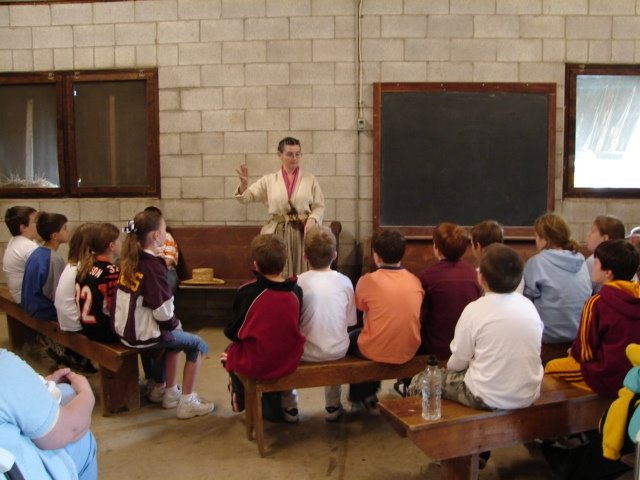
Here I am holding our Town Meeting, where students re-enact a Town Meeting in early America, learning about democracy and voting rights.
Hands On History - Spring 2006 - Woodworking
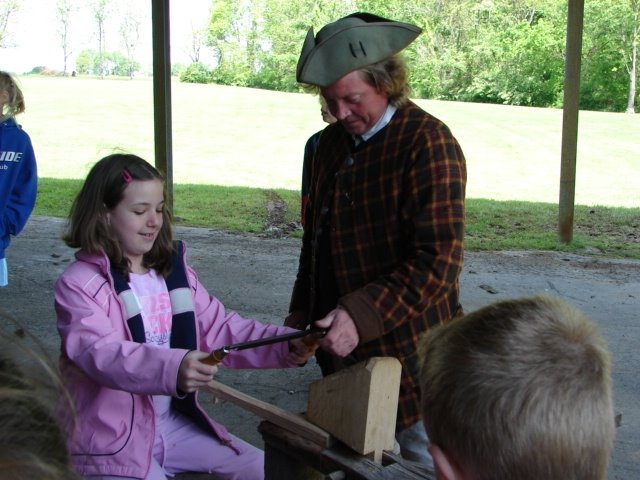 Mike Thompson teaches about woodworking. Here we see a student learning to use a draw knife.
Hands On History - Spring 2006 - Oxen and Wagon
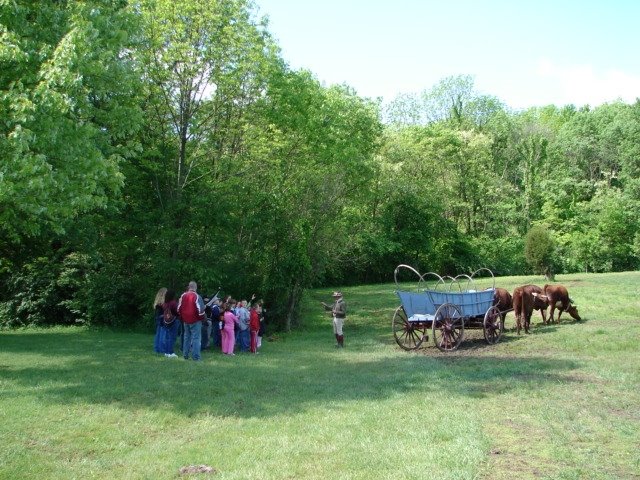 Wilmington Meeting members took some photos at Quaker Knoll Campground during the Spring session of the Hands On History program.
Here we have a group of students attending the Oxen/Freight station. Below is Gerry Barker teaching about early Freight.

Thursday, June 29, 2006
Hands On History - Brief description of topics
Some of the topics our Hands On History program may include, but are not limited to:
Our 2006 Autumn program runs October 3-6, 9-13 and 16-17, 2006. Our 2007 dates are May 14-24, 2007 and Oct 1-11, 2007. The program takes about 4 hours, running from 9:30 a.m. until 2:00 P.M, or as your busing schedule permits. Cost is $5.00 per student. There is no cost for teachers and chaperones.
Please contact me for additional information, or to schedule your visit.
OXEN- An explanation of the importance of oxen to early
QUAKER HISTORY - Early Quaker History and how Quaker's influenced Southwestern Ohio and the Early United States.
CHILDREN’S WORK- A view of the importance of children on the frontier while they work to shape a grindstone.
FRONTIER
TOWN MEETING- Students experience frontier democracy by taking part in a town meeting and wrestling with a vital issue of the day.
SPINNING- An introduction to the problem of cloth supply for the
CHILDREN’S GAMES- A look at entertainment on the frontier while students try an outdoor game of the 1800s.
WESTERN MOVEMENT -
INDENTURED SERVITUDE- Forty percent of the population of Colonial America arrived under terms of indenture. This station examines the lives of the children who found themselves so situated.
Our 2006 Autumn program runs October 3-6, 9-13 and 16-17, 2006. Our 2007 dates are May 14-24, 2007 and Oct 1-11, 2007. The program takes about 4 hours, running from 9:30 a.m. until 2:00 P.M, or as your busing schedule permits. Cost is $5.00 per student. There is no cost for teachers and chaperones.
Please contact me for additional information, or to schedule your visit.
Hands On History - Overview
For several years Frontier Resources, a non-profit organization I'm involved with, has offered a school program designed to capture the interest of the student of Ohio
Frontier Resources is an organization that designs and presents programs to students all over the country. Our specialty is “Hands-On History”. Our programs are designed to give students a taste of the activities, both work and play, of children of early
Quaker Knoll Campground is a lovely site on the north end of Cowen Lake State Park.
Our 2006 Autumn program runs October 3-6, 9-13 and 16-17, 2006. Our 2007 dates are May 14-24, 2007 and Oct 1-11, 2007. The program takes about 4 hours, running from 9:30 a.m. until 2:00 P.M, or as your busing schedule permits. Cost is $5.00 per student. There is no cost for teachers and chaperones.
Please contact me for additional information, or to make your reservation.
Subscribe to:
Posts (Atom)